
New to Smoke-Free Nicotine? The Complete 2026 Starter Guide
Deciding to go smoke-free is the easy part. The moment you actually try to start, a wall of choices and jargon appears — vaping or pouches, prefilled or refillable, what strength, which flavour, where to buy, and a fog of half-remembered warnings about whether any of it is safe or legal. It’s enough to send a would-be quitter back to the certainty of cigarettes. This guide exists to clear that fog. It’s a complete, practical starter manual for anyone new to smoke-free nicotine in 2026: how to choose your route, how to get the crucial first decisions right, what to buy for a first attempt, what the early days feel like, and how to avoid the common mistakes that derail beginners. No assumptions, no jargon left unexplained — just the straight path from ‘I want to switch’ to ‘I’ve switched’.
First, the Reassurance
Before the how-to, some grounding, because misinformation stops people before they start. Smoke-free nicotine products — vaping and pouches chiefly — are, according to UK public health bodies, substantially less harmful than smoking, because they remove the combustion that causes the overwhelming majority of smoking’s harm. They’re not risk-free, they contain addictive nicotine, and they’re strictly for adults who already smoke or use nicotine — but for a smoker, switching completely represents a major step in the right direction. They’re also legal, regulated products when bought from established UK retailers: vaping is tightly governed, and tobacco-free nicotine pouches are legal for adults. So if you’ve been hesitating because you’re unsure whether switching is ‘worth it’ or ‘allowed’, the honest answer is that for a smoker, it’s both a recognised harm-reduction step and entirely legal. With that settled, let’s get you started.
Choosing Your Route
Your first real decision is which type of product to start with, and the best way to choose is by asking what you’ll miss most about smoking. If you’ll miss the physical ritual — the hand-to-mouth, the inhale, the exhale, the pause — vaping is your natural starting point, because it replaces that behaviour better than anything else; a simple pod kit is the easiest entry. If you’d rather have nicotine invisibly and don’t need the ritual — you want it discreet, at your desk, on the move — nicotine pouches suit you better (note: pouches are tobacco-free products, distinct from banned traditional snus — for clarity on that distinction, see what is snus). If you want a pharmacy-guided, clinically-backed route, traditional NRT like patches and gum remains excellent. Many people eventually use more than one, but for a first attempt, pick the single route that best matches the biggest gap cigarettes will leave. For most switching smokers, that’s vaping — which is why we’ll use it as the main worked example, though the principles apply across all routes.
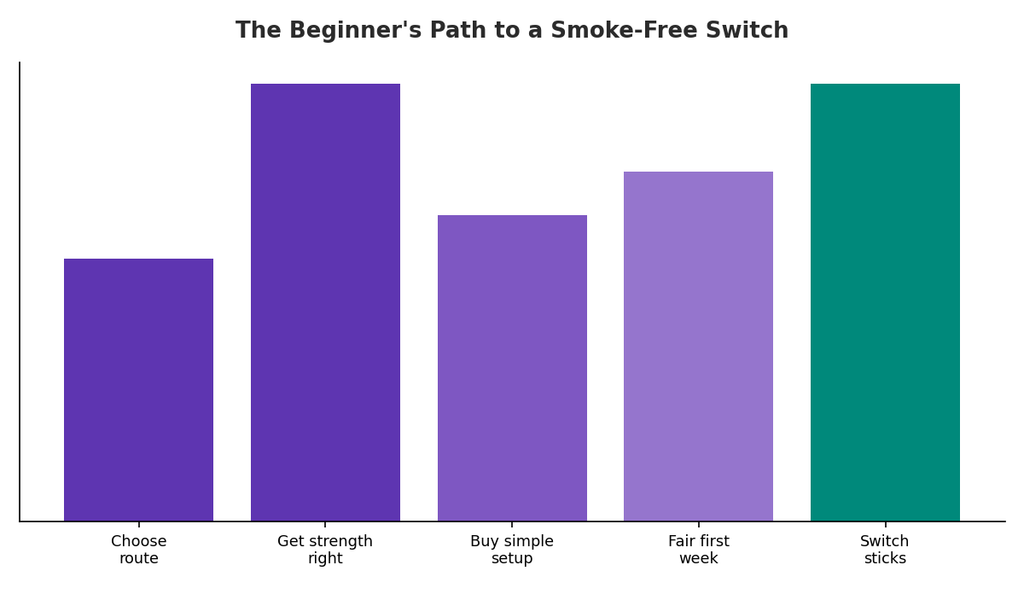
The beginner’s path — from choosing a route to a switch that sticks.
The Make-or-Break Decision: Strength
If you take one thing from this guide, take this: get your nicotine strength right, because it’s the decision that most determines success. The universal beginner mistake is starting too low out of caution — which leaves cravings unmet, drives frustration, and sends people back to cigarettes concluding that ‘it didn’t work’ when really the dose was simply too small. Match your starting strength to your actual smoking habit. For vaping, a ten-a-day-or-more smoker should start at 20mg nicotine salts — the strength designed to genuinely replace cigarettes — not a timid lower number. For pouches, choose a strength suited to a switching smoker. Reduction comes later, gradually, once your switch is stable and smoking feels foreign — not on day one. In switching, the stronger product is usually the safer choice, which is the opposite of most people’s instinct, and getting it right is half the battle won.
What to Buy for a First Attempt
Keep your first purchase simple and sensible. For a vaping start: a beginner-friendly pod kit — prefilled for maximum simplicity, refillable if you’ll trade a little fuss for lower cost — at your correct strength, plus two or three flavours rather than one (so a flavour you dislike isn’t a wasted purchase; explore ranges like Hayati Flavours to find profiles that appeal), a spare pod, and a USB-C cable if you don’t have one. Modern rechargeable pod kits are built for exactly this first-timer scenario, and a good retailer’s range makes choosing straightforward. For a pouch start: a couple of flavours at an appropriate strength, again buying a small variety rather than committing to one. The total outlay for a proper first setup is modest — well under what a fortnight of smoking costs — and deliberately so, because you’ll learn your real preferences within a month and can refine from there. Don’t overspend on a first attempt; buy enough to start well and learn.
The First Weeks, Honestly
Knowing what to expect protects your switch. Week one is substitution: use your product wherever you’d have smoked, don’t ration yourself, and count any cigarettes that still happen as data, not failure — every one replaced is progress, and the balance usually tips toward your new product as you build trust in it. Give it a fair week rather than judging on day one, especially as your smoke-conditioned senses recalibrate and flavours sharpen. Weeks two to four are consolidation: your trigger moments arrive on cue and get handled with the new tool until it becomes automatic, and a wobble of doubt around day ten to fourteen is standard and passes. Keep your product where cigarettes used to live, always stocked and (for vaping) charged, with a spare handy. By week four, many switchers notice whole stretches where smoking simply didn’t occur to them — which is the switch taking hold.
Avoiding the Beginner Traps
A handful of mistakes derail beginners, all avoidable. Under-dosing on strength — covered above, and the biggest. For vaping specifically: skipping the coil-priming wait (always wait two to three minutes after fitting a new pod before your first puff, or you’ll scorch it), and drawing too hard (gentle two-second pulls, not cigarette-style drags). Buying only one flavour and hating it on day two. Judging the whole experience prematurely rather than giving it a fair week. Rushing to cut your nicotine before your switch is stable. And buying from dodgy sources — always use established UK retailers and check for compliant packaging and age verification, since counterfeit products are a needless risk. Sidestep these and the path is remarkably smooth; nearly every ‘smoke-free didn’t work for me’ story traces back to one of them, usually the strength.
Your First Week Checklist
To turn all this into action, here’s a simple first-week checklist. Before you start: choose your route (vaping for ritual, pouches for discretion, or both), buy a sensible setup at the correct strength for your smoking habit, with two or three flavours and any essentials like a charging cable or spare pod. Day one: if vaping, charge fully and remember to prime each new pod with a two-to-three-minute wait; use your product wherever you’d have smoked, without rationing. Through the week: keep it where your cigarettes lived, always available; draw gently if vaping; give flavours and the experience a fair trial rather than judging early; and count any cigarettes that still happen as data, not failure. End of week one: you should be substituting most or all cigarettes, and settling into which flavours you like. This checklist covers the fragile early days where most switches succeed or fail — follow it and you’ve given yourself the best possible start.
Setting Yourself Up for the Long Term
Beyond the first week, a few habits set up long-term success. Establish a reorder routine so you never run out — buy from an established retailer whose account remembers your preferences, and reorder when you open your spare rather than when you run dry, deleting the emergency-purchase that catches so many people. Build a small flavour rotation to avoid palate fatigue. Resist the urge to cut your nicotine strength until your switch is genuinely stable and smoking feels foreign — usually months in, not weeks. And if you’re using vaping, keep up the tiny maintenance habits (priming, gentle draws, upright storage) that keep the experience smooth. These aren’t onerous — collectively they’re a few minutes of attention — but they’re what turns a successful first month into a permanent switch. The goal from here is simply consistency: a smoke-free routine reliable enough that you stop thinking about it, which is exactly the state in which people stay off cigarettes for good.
You Can Do This
A final word of encouragement, because the wall of information can make switching feel harder than it is. Millions of people have successfully gone smoke-free with these products, including many who’d failed repeatedly with willpower or older methods, and there’s no reason you can’t join them. The tools available in 2026 are genuinely effective, the path is well-trodden, and the common pitfalls — under-dosing, impatience, buying badly — are all avoidable with the guidance in this article. You don’t need to get everything perfect; you need to choose a sensible product at the right strength, give it a fair chance, and keep going through the early adjustment. If a particular product doesn’t suit you, try another — the variety exists precisely so you can find your fit. Your past failures were most likely a tools-and-approach problem, not a reflection of your capacity to quit. With the right approach, going smoke-free is genuinely achievable, and the rewards — financial, practical and in health terms — are substantial and lasting.
Frequently Asked Questions
What’s the single most important decision? Getting your nicotine strength right for your smoking habit — under-dosing is the top reason switches fail. Vaping or pouches to start? Vaping if you’ll miss the ritual, pouches if you want discretion; many end up using both. How much should I spend first? Modestly — a sensible setup costs well under a fortnight of smoking, and you’ll refine once you know your preferences. How long until it feels normal? Give it a fair week or two; the early unfamiliarity is your senses recalibrating, not a sign you chose wrong. What if my first flavour disappoints? Buy two or three to start, so it’s not a wasted purchase. Where should I buy? Established UK retailers with proper age verification and compliant products. And can I really do this? Yes — millions have, including many who’d failed before; the right tools used properly make it genuinely achievable.
The Path Is Well-Trodden
Take comfort that the path ahead of you is well-trodden and well-mapped. Everything in this guide — the strength advice, the route-matching, the first-week checklist, the common traps — comes from the accumulated experience of millions who’ve switched before you, including huge numbers who’d failed repeatedly and then succeeded once they had the right approach. You’re not pioneering anything or relying on willpower alone; you’re following a proven route with effective tools. The unfamiliarity of the first days is normal and passes, the wobble around day ten to fourteen is standard and passes, and by week four many people find whole stretches where smoking simply doesn’t cross their minds. Choose sensibly, get your strength right, be patient with the adjustment, buy genuine, and give yourself the fair chance the right approach makes possible. The switch is achievable, the rewards are substantial, and countless people just like you have already made it stick.
The Bottom Line
Starting with smoke-free nicotine in 2026 is far easier than the wall of choices makes it look, once you have the path: choose your route by what you’ll miss most about smoking, get your strength honestly right (the single most important decision), buy a simple sensible first setup with a couple of flavours, give it a fair few weeks, and sidestep the handful of common traps. Do that and you give yourself the genuine chance that the right approach — used properly — finally makes possible, whether your route is vaping, pouches, or a combination. Buy genuine, be patient with the first fortnight, and let the goal of staying off cigarettes guide every decision. As always: these products are for adults aged 18 and over who currently smoke or use nicotine, as substantially less harmful alternatives — and if you don’t already, the best start is not to.